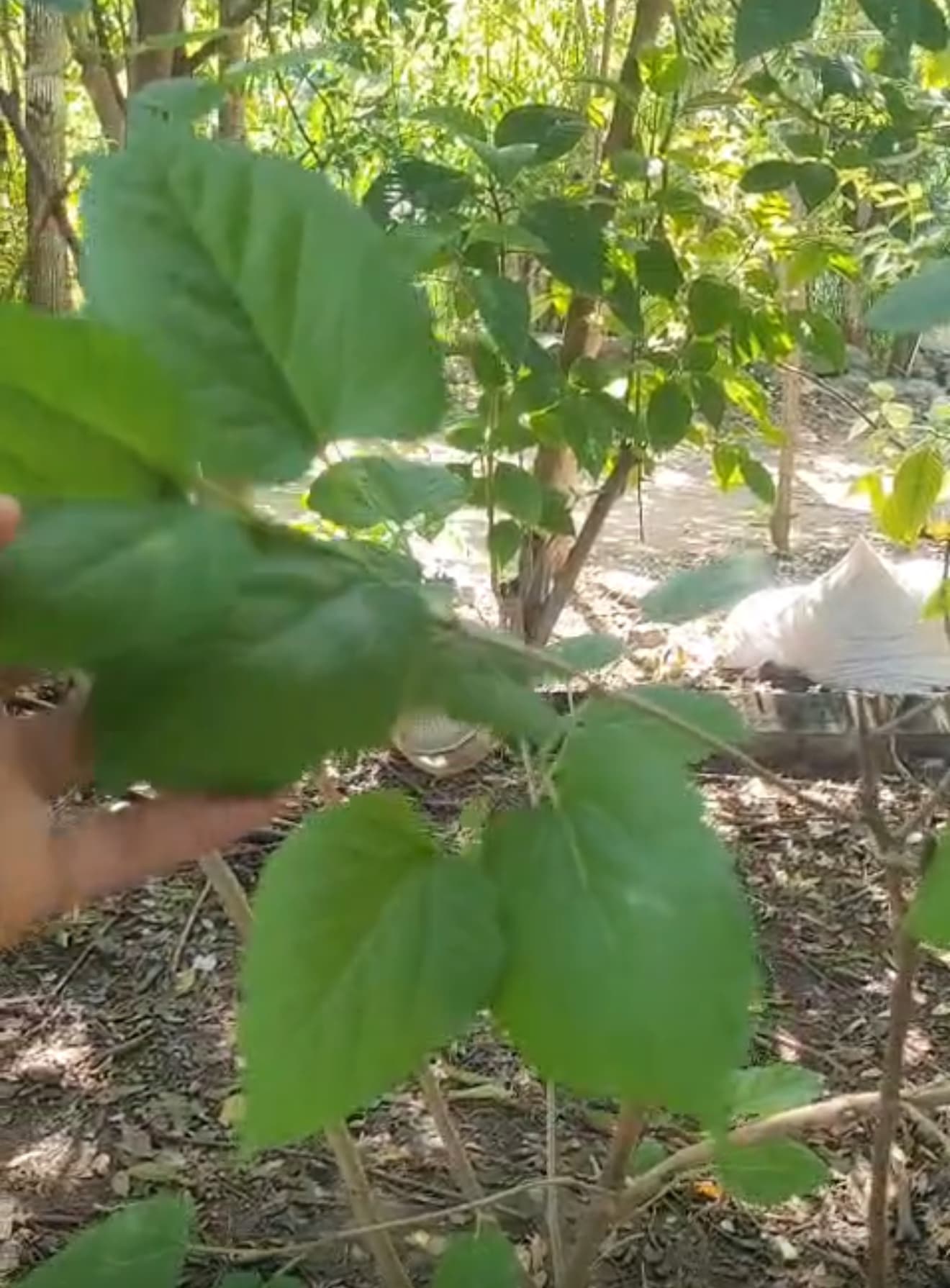
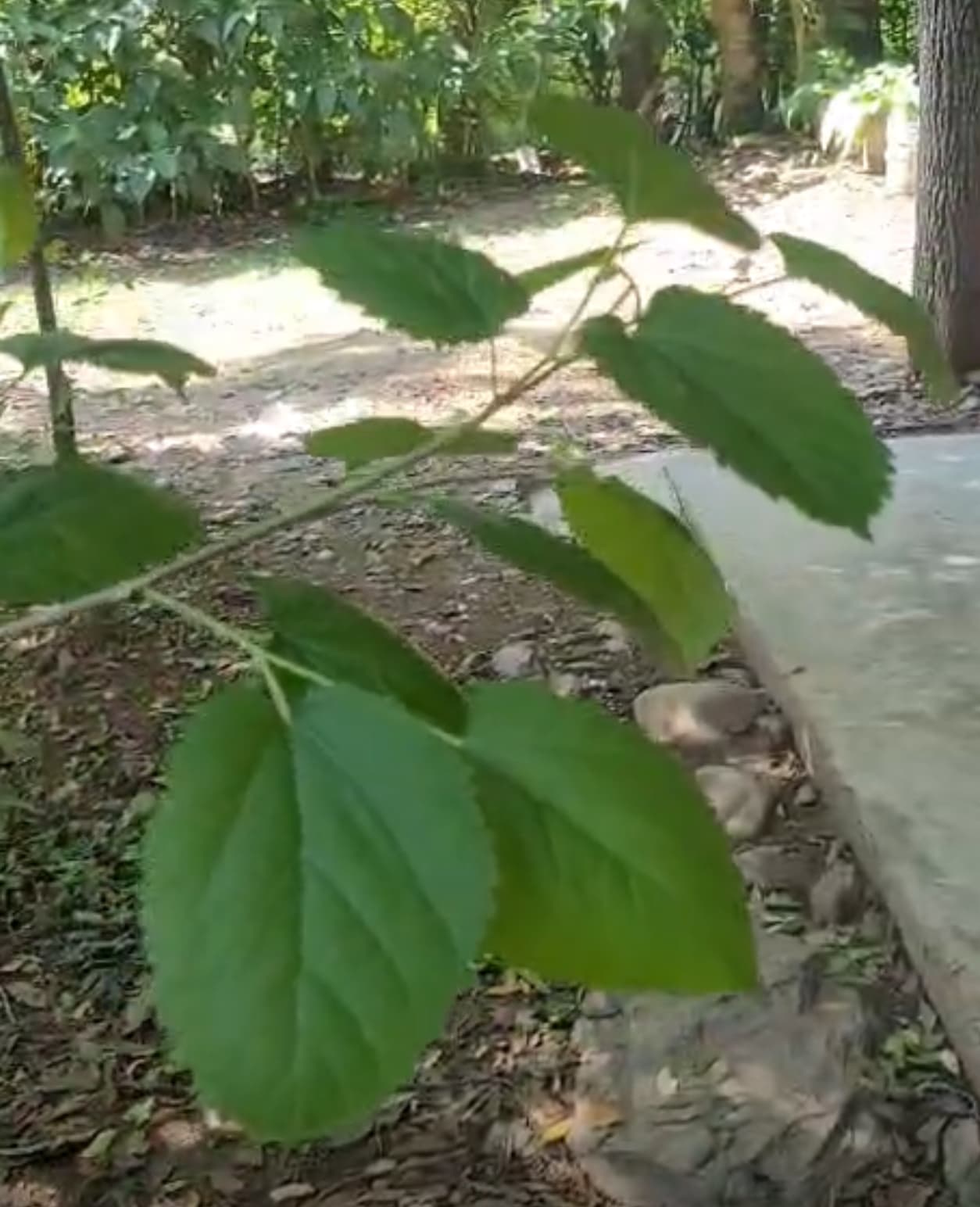
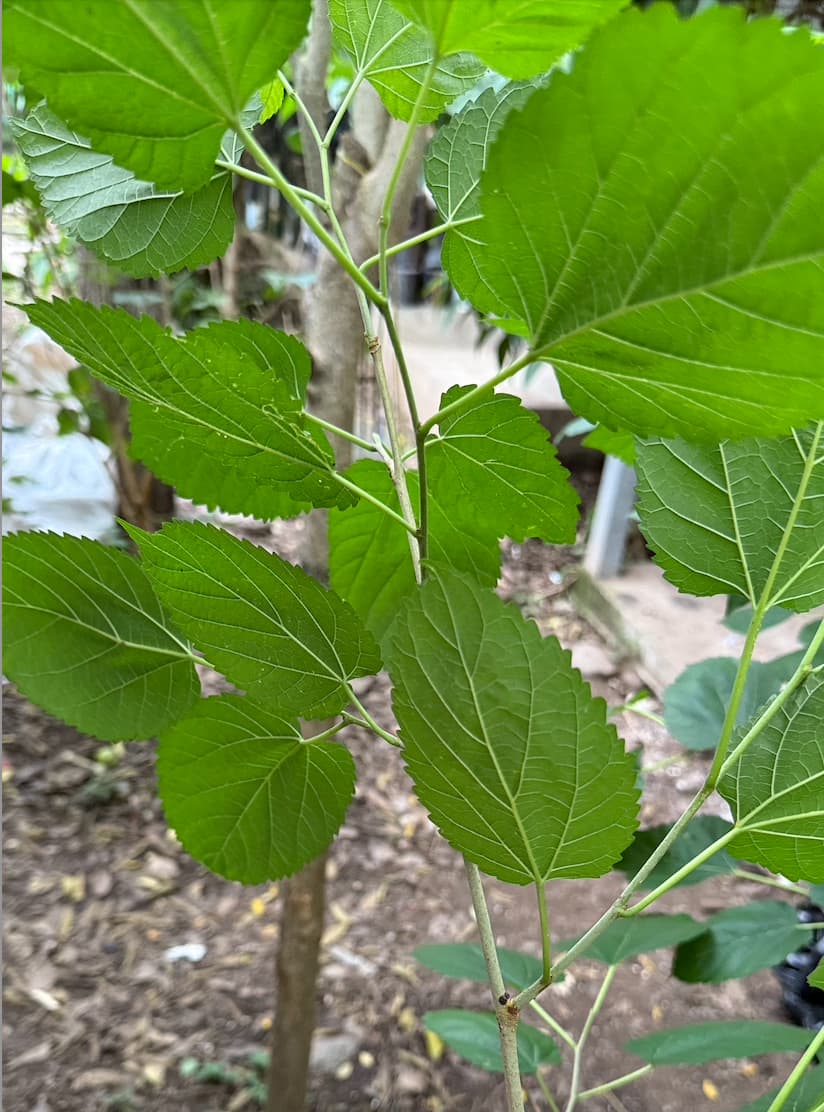
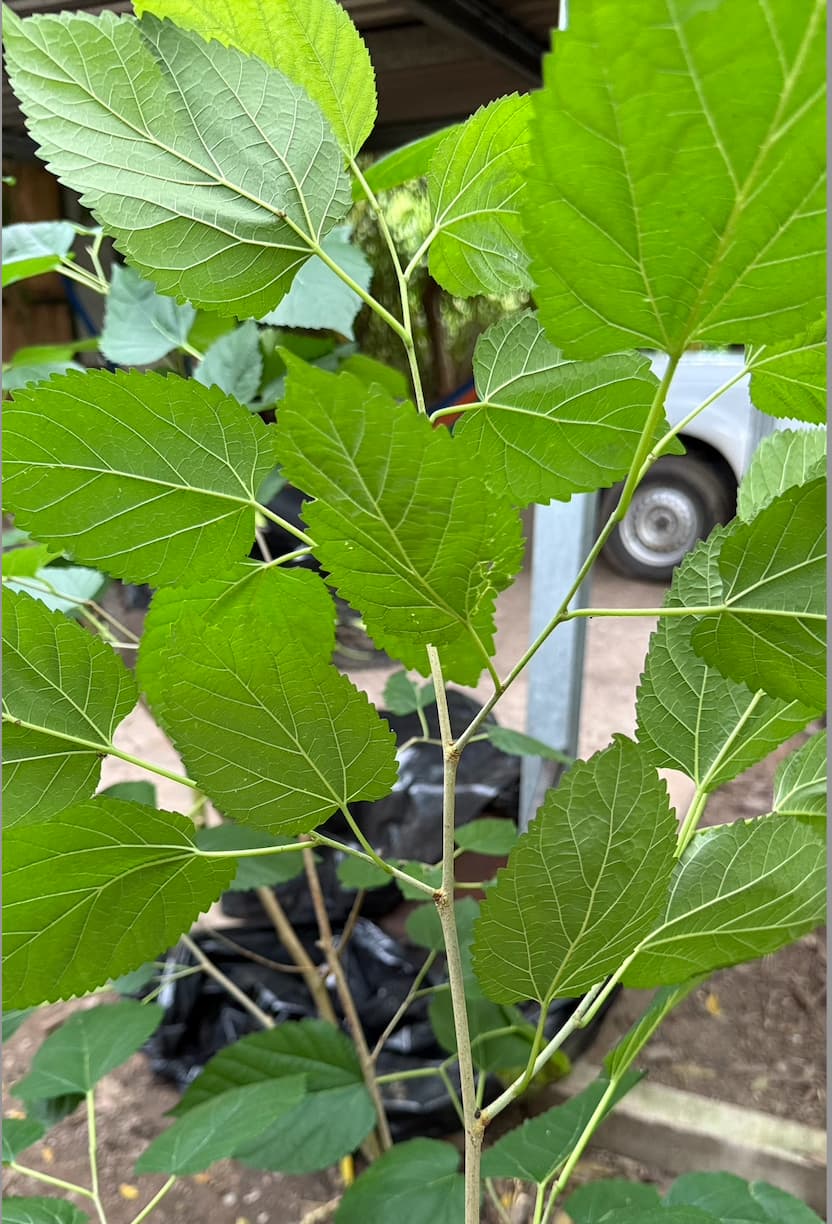
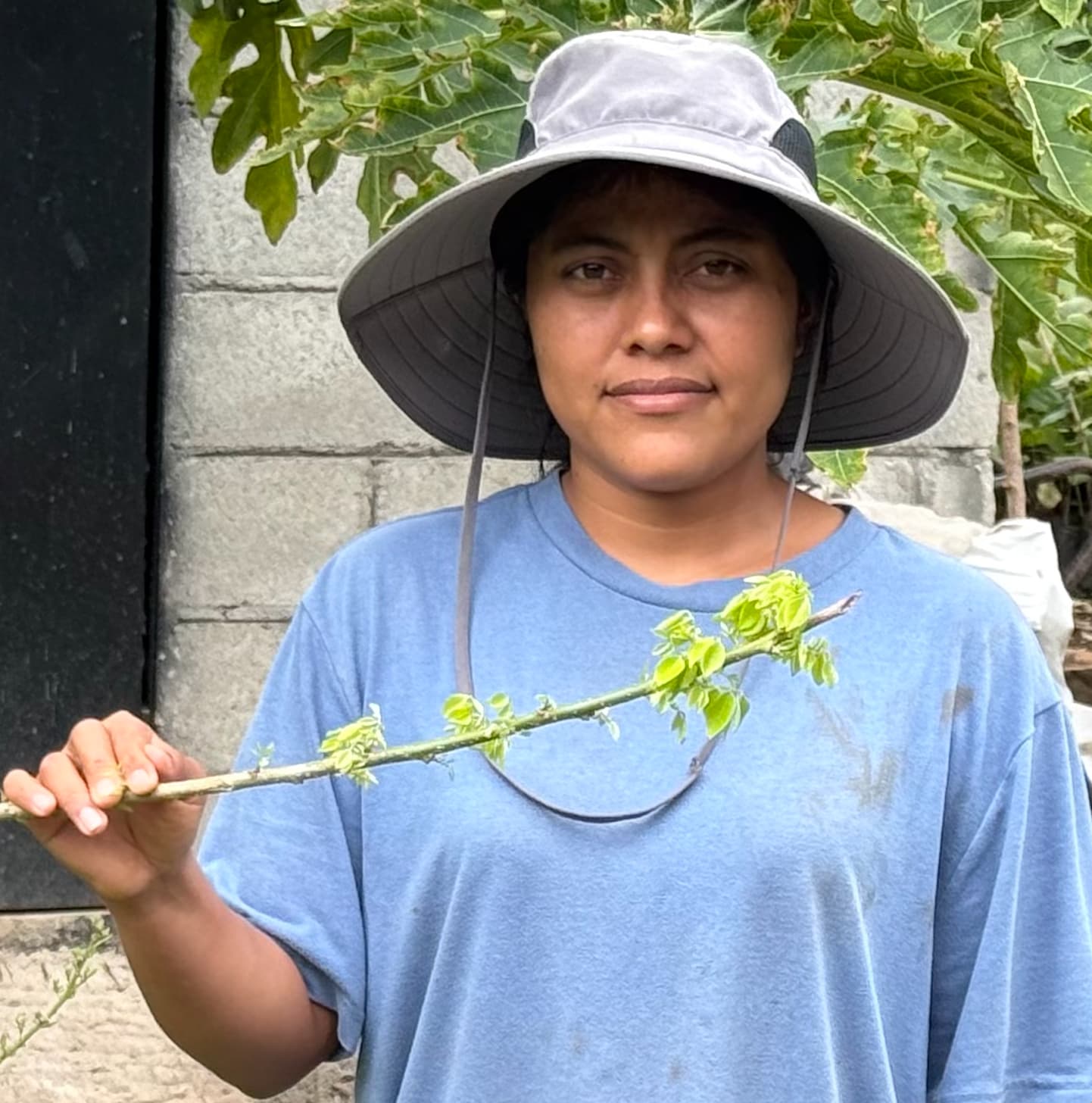
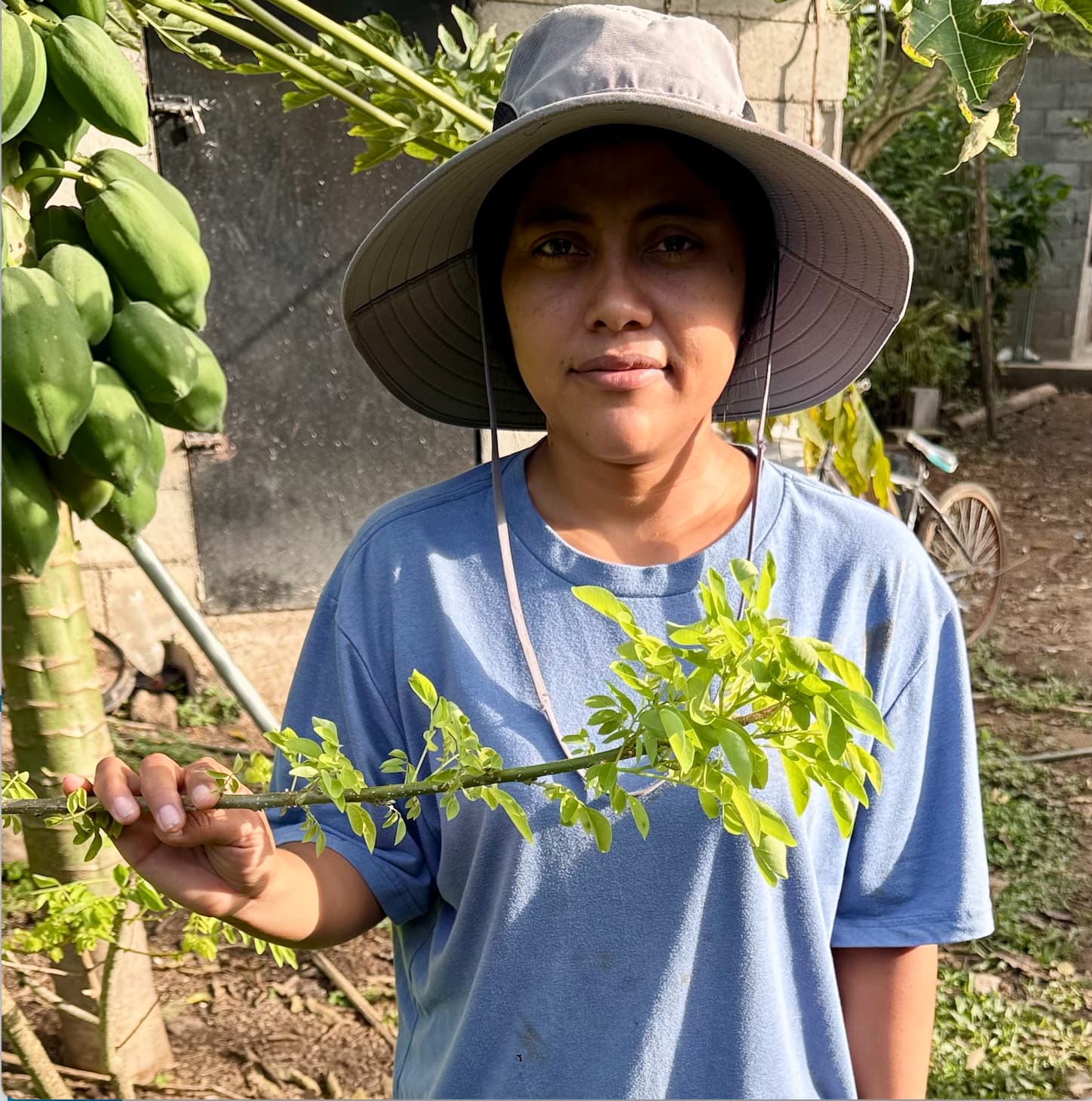
We harvest leaves every day for feeding our chickens, rabbits, sheep, and ducks. As you know from my other posts, we mostly only grow perennial plants. Thus most of the leaves we harvest are from trees. Unless we are doing pruning, we only harvest the leaves. In other words, we do not cut the branches. It takes a long time to regrow the branch, but it only takes a few weeks to regrow leaves. We have discovered that if we harvest 100% of the leaves off of a tree, they re-grow very quickly as compared to harvesting only 50% of the leaves off of the tree.
We recently tested with morus alba trees growing in the same area. So, they have the same soil and water conditions, sunlight, etc. The soil is very rocky and highly compacted from foot traffic. We harvested 100% of the leaves of some trees and only 50% of the leaves from the other trees. The trees whose leaves were harvested at 100% rate, returned to full leaf coverage in 30 to 40 days. At the same time those trees harvested at a 50% rate had only begun to form new leaves.
Because our focus is helping the rural poor with very limited land to have a better life, this technique can be a game changer.
This is really interesting! Do you find that when the leaves re-grow they form a small branch off of the main truck or do they just have a petiole off of the main truck (like the first time they push leaves)? Can you send a photo fo the regrowth?
Will try to take some photos and send to you, but the regrowth is normal as it was originally. In other words, not a new branch.
We have only tested it on morus but we are about to do the same with Leucaena y gilricidia y chaya.
For comparison, another nearby tree of the same size, we only harvested 50% of the leaves. It shows no sign of new leaves forming yet.
For us, this is a real game changer because before our experiment we thought harvesting 100% of the leaves would shock the tree and thereby slow the reproduction. So we had only been harvesting 25 to 50%.
We use a variety of techniques but during the drought season, when feed is in short supply, we simply go down the branch, breaking off each petiole individually. That’s what we did in the photo above with one of our students holding the branch to be able to better see the size of the leaf regrowth compared to her hand. Will send another pic today, which is 7 days later, to see how the petiole is regrowing.
@Stacy_Swartz This is definitely worth a try. I’ve done this with some trees/shrubs in the past, especially for feeding pigs, but maybe I will start doing it on a larger scale. I have been pollarding most of the tree forages here but it does make dry/cool season hard for them if you harvest too much too late in the year. If this works really well, it may be better to let them bush out and just take the leaves. @AFHGlen The 100% amount is very interesting; my instinct would be to harvest around 50-75%, like you said, and leave some leaves to help the tree recover. On the trees that you harvested 50%, from what parts of the tree did you take/leave the leaves?
We harvested from trees that were approximately 8 to 10 feet tall. They had flexible branches so we could pull them down to remove the leaves. Some of the trees we removed all of the leaves from every branch. The other trees we removed every other petiole on every branch. Maybe the results would’ve been different had we removed all of the leaves from half of the branches.
Just getting around to my update on this subject- I am very impressed with the amount of regrowth I get from stripping the leaves. The plants recover way faster and produce way more biomass than with normal pruning.
This makes a lot of sense; if the plant doesn’t have to regrow wood (only leaves), that takes way less energy. In the same way that pruning (or other stresses) induce flowering, the stripping seems to stress the plant into more biomass production, and I got the best results from stripping the whole plant, as close to 100% as possible (without wasting time trimming every little leaf). I think that the whole plant needs to be done at the same time, or at least in the same day or two, otherwise it just puts all of its energy into the unharmed branches.
I was wondering about why I don’t see more effort on the part of the plants to produce flowers and fruit. It really does seem like they go 100% for leaf regrowth. My guess is that, primarily, it is because these plants were already being used for forage, and they have been pollarded/coppiced. Pollarding perpetually keeps plants in the juvenile state, when they are focused on tissue growth and not reproduction, and that is extending to the stripping of the leaves and not just the pruning of branches.
My final thought is that this is also probably healthier for the tree. There is no removal of wood, and no exposure of the growing tissue that could enable disease to enter. It is way less effort for the plants to recover, which means less stress (and stressed plants are sick plants). Thank you for this post! This is a new discovery for me and one that I think could be very beneficial to a lot of people.
Glad to know that you found the idea helpful. It has been extremely productive technique for us.
In terms of why the plant is not inclined to produce flowers and fruit, one reason might be the plant needs a certain number of sunlight days before it’s ready to produce a flower. By stripping the leaves periodically it never gets enough sunlight days.