Thanks @Jeremy_DuCheny! Good questions.
Manure for Fertility
Increased fertility (especially nitrogen) can increase duckweed (Lemna minor) protein percentage. The faster growth rates from higher fertility will also increase total protein yield, which is potentially even more useful.
The question of what type of manure is tricky, as even manure from the same species will differ in nutrient concentration. What matters is the nutrient content rather than the species. We have tried with both aged and fresh cow manure, and fresh poultry manure here. All result in increased growth rates, but there is little consistency in the results. Poultry manure typically has much more concentrated nutrients. Too much can ‘burn’ the plants, but we haven’t yet added enough to observe this. We are also careful with adding poultry manure to water than then could end up fed back to poultry - it needs to be rinsed and there is still a disease risk.
We’ve done trials with different rates of fresh cow manure and the impact on both duckweed and azolla growth. A slurry with a ratio of 1 part manure to 19 parts water, applied at 1 liter to 6 liters of water (around 15% by volume), was our most productive treatment. If your tank was 100 liters, this would work out to be around 1kg (maximum) of cow manure.
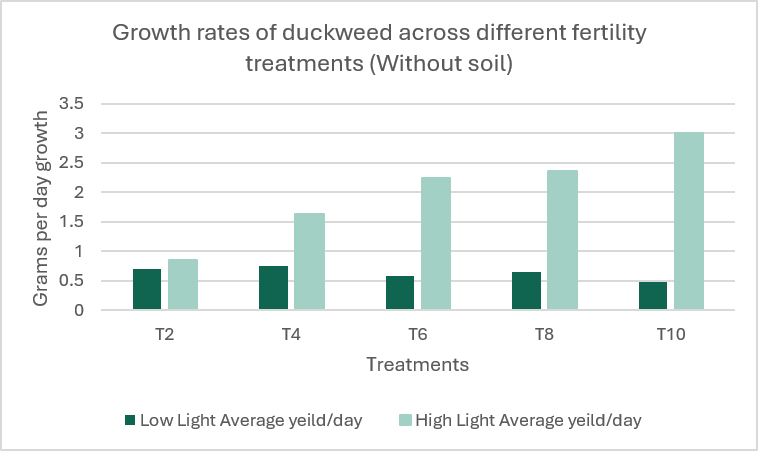
The figure below shows the results of two simple trials we did on cow dung slurry added to duckweed. One trial was in very low light and the other in medium/high light conditions, but they had the same manure treatments added. Treatment T10 is the ‘recipe’ I describe above.
Practically, you would need to give it a try and observe. Adding 1% manure by volume would be a good starting point.
Ratio for adding duckweed to feed
There is quite a bit of research suggesting dietary inclusion at 5-10% of dry matter fed typically improves poultry production. Over 15% often leads to production losses (Sońta et al., 2019). Because fresh duckweed is usually more than 90% water, this means that 5% duckweed on a dry weight basis is closer to 33% by fresh weight. Chickens will probably refuse to eat this much fresh duckweed.
The actual amount to add will depend on the other ingredients. Duckweed is reasonably high in protein but also high in fiber.
Practically at a small scale, providing duckweed as a supplement up to the appetite of the chickens is a good place to start. If you are formulating and pelletizing feed for example, then you’d want to calculate out the least-cost ration, making sure duckweed is no more than 10-15% on a dry matter basis.
Duckweed by itself is not going to provide enough protein for optimal production in a commercial system. It might allow you to reduce the amount of higher cost protein food sources. For semi-scavenging chickens in the tropics, providing duckweed as a supplement will likely increase protein intake.
Storage
Yes! If dried enough it will store well. The drier it is the longer it will store.